
Differential Identification
Toyota has provided 4 differential types in pickups and 4Runners -- the 8" standard, the 7.5", the 8" V6/Turbo, and a new one in the Tacoma and third-generation (96+) 4Runners.
The most common is the 8" standard. It is used in the rear axle on '79-95 (96?) 4WD trucks and 4Runners, and 3/4 and 1 ton 2WD pickups, and it is also used in the front axle on 79-85 (solid beam) pickups and 4Runners.
The 8" V6/Turbo axle is found in some turbo and V6 models, and is a little beefier. It is a 4-pinion design, whereas the regular 8" is a 2-pinion design. Many V6's had 2-pinion cases too.
The 7.5" differential is used in the front of IFS trucks ('86 and later). It is also used as the rear differential on some 2WD trucks.
The 8-inch Toyota axles are strong and utilize a third-member setup, much like the 9-inch Ford. This means the 'guts' of the axle can be easily removed for servicing or gear and differential carrier changes. It also means that its easy and fairly cheap to buy and ship third members from differential specialists.
I don't know much yet about the Tacoma/96+ 4Runner differential. There is a factory option for a manually-operated locker. If you buy a new Tacoma or 4Runner, Get this option; it will improve your off-road ability tremendously.
Working on the Axles
Setting up ring and pinion gear clearances properly is said to be a difficult task best left to professionals. So if you want to change your gearing or your differential carrier, unless you really know what you're doing, consider taking it to a professional that specializes in such work. Most 4x4 shops set up diffs frequently. Figure $150-$200 per axle just for the labor. I've been quoted between $1000 and $1500 for a complete gear change (both axles, including parts, labor, gaskets, fluids, etc.).
Another option is to buy a third member that is already set up the way you want, and install the entire third member as a unit, which is much easier to do yourself than a full gear setup. NWOR and West Coast Differentials sell complete Toyota third members ("Starting at $325").
Otherwise, you can buy the gears and do it yourself.
Gearing
I could use some help here figuring which codes are common! Please take a moment to email me with your C/TR/A/TM code, engine type, transmission type, model year, stock tire size, and country of purchase of your truck, and I will update the table below. I'm trying to figure out exactly which gearsets were offered with the various engine/transmission combinations. If you have other Toyota vehicles, give me those codes too; I'd like to make this table as complete as possible, and would like to see if there are other cheap swap possibilities.
Most Toys sold in the US have 4.10 axle gearing, but this isn't always the case. Four cylinder models with auto trannies often have 4.30 gearing, (4.87 if they came factory-equipped with 31" tires). All V6's with 31" tires and 4-cylinder manuals with 31" tires usually had 4.56 gears. And still others have been changed by their owners, to move oversized tires.
One way of determining your axle type and stock gearing is to look for an Information Plate on your truck, on the firewall (prior to 1989) or door jamb (1989-current). It will look something like this:
C/TR/A/TM 138 HR11 G282 A130H or C/TR GJ7/KQ41 A/TM G251/R150F
These numbers are the Color (paint) code, Trim Code, Axle Code, and Transmission Code. You will also need to check the first few digits of you VIN #.
The first position of the Axle Code is a letter which identifies the diameter of the ring gear. Toyota trucks and 4Runners have always used the 7.5" and 8" diameters, but the others are listed here for completeness. The first table applies to Japanese-built Toyotas, which have VIN numbers beginning with "JT". The second smaller table applies to North American vehicles with a VIN beginning with "4T".
For example, my Japanese truck's code is G282. This means I have an 8-inch (rear) axle, 4.30 gears (which is common with automatic transmissions), and a 2-pinion design (common in 4 cylinders).
The highlighted cells in the first table are the values you are most likely to find in Toyota 4Runners and Pickup Trucks.
| Toyota Differential Code Decoder - Vehicles with JTxxxxxx... VINs | ||||
|---|---|---|---|---|
| First Position - Diameter of ring gear | Positions 2 & 3 - Gear Ratio | Final Position - number of pinions in the carrier | ||
| A = 138mm | 01 = 3.300 | 25 = 4.556 31" tire option |
49 = 3.729 | 2 = 2 Pinions Common in 4 cylinder models, but has been used in some V6 models |
| B = 145mm (NOT in trucks or 4Runner) | 02 = 3.360 | 26 = 5.571 | 50 = 3.400 | |
| C = 6.25" | 03 = 3.545 | 27 = 3.364 | 51 = 3.736 | 3 = 2 Pinions (LSD) (I've not ever seen this code in a pickup/4Runner) |
| D = 6.662" | 04 = 3.556 | 28 = 4.300 AT, 225/75 |
52 = 3.722 | 4 = 4 Pinions Common in V6 and Turbo models |
| E = 7.1" | 05 = 3.700 | 29 = 4.100 Very common |
53 = 3.250 | |
| F = 7.5" | 06 = 3.889 | 30 = 3.727 | 54 = 3.941 | 5 = 4 Pinions (LSD) (I've not ever seen this code in a pickup/4Runner) |
| G = 8.0" All 4x4 4Runners and Pickups |
07 = 3.900 4x2 4R V6 AT also '81 4x4s |
31 = 3.909 | 55 = 3.333 | |
| H = 9.0" | 08 = 4.111 | 32 = 6.591 or 4.807 | 56 = 2.821 | |
| J = 9.25" | 09 = 4.222 | 33 = 7.503 or 5.583 | 57 = 4.058 | |
| K = 9.5" | 10 = 4.375 '80 4x4 |
34 = 6.781 or 4.786 | 58 = 3.238 | |
| L = 10.5" | 11 = 4.444 | 35 = 7.636 or 5.600 | 59 = 3.234 | |
| M = 12.5" | 12 = 4.625 | 36 = 4.778 | 60 = 3.519 | |
| N = 13.5" | 13 = 4.790 | 37 = 3.583 | 61 = 2.724 | |
| P = 14.0" | 14 = 4.875 31", AT 22RE |
38 = 3.417 | 62 = 2.892 | |
| Q = 12.0" | 15 = 5.125 | 39 = 3.154 | 63 = 2.655 | |
| R = 162mm | 16 = 5.286 | 40 = 5.375 | 64 = 4.312 | |
| S = 6.38" | 17 = 5.600 | 41 = 3.308 | 65 = 3.837 | |
| T = 6.7" | 18 = 5.714 | 42 = 6.500 | 66 = 3.071 | |
| U = 6.0" | 19 = 5.833 | 43 = 3.550 | 67 = 3.526 | |
| V = 10.6" | 20 = 6.167 | 44 = 3.214 | 68 = 3.095 | |
| W = 15.5" | 21 = 6.667 | 45 = 3.533 | 69 = 4.176 | |
| X = 142mm | 22 = 6.780 | 46 = 2.929 | 70 = 5.857 | |
| Y = 158mm | 23 = 6.833 | 47 = 3.944 | 71 = 2.962 | |
| Z = 202mm | 24 = 7.640 | 48 = 3.356 | 72 = 3.949 | |
| 73 = 4.285 | ||||
| Toyota Differential Code Decoder - Vehicles with 4Txxxxxx... VINs | |||
|---|---|---|---|
| First Position - Diameter of ring gear | Positions 2 & 3 - Ratio | Final Position - Differential type | |
| A = 7.5" | 01 = 3.42 | 02 = 3.58 | A = 2 Pinion, Open |
| B = 8" | 03 = 4.10 | 04 = 4.56 | B = 4 Pinion, Open |
| 05 = 3.15 | 06 = 3.91 | C = 2 Pinion, OEM Limited Slip | |
Differential Types
Open Differentials
Until recently, all Toyota trucks came from the factory with open differentials, though the '96 4Runner has a factory locker as an option (get it!). Open diffs are cheap, reliable, and provide smooth highway performance, but can get you stuck easily on ice or sand, because power goes to the wheel on each axle that has the least traction. 4WD with open diffs means you can count on only 2 wheels to get any power, and they will be the ones on each axle that are slipping.
Spools
A spool is carrier setup that turns both wheels on an axle the same speed as the ring gear. Spools are lousy on pavement because there is no differential action, and they eat tires (especially if you ever turn corners :). But you can always count on power to both wheels. Spools are common in drag racing. I don't know of any manufacturer that makes spools for Toys - but there's an easy way to fabricate one: Just take your open diff, and weld your spider gears to the carrier. This is often referred to as a "Lincoln Locker" because there is a good chance your welder was built by Lincoln Electric. I can't think of many situations where a spool would be a preferable modification to a Toyota 4x4, except maybe on a trail-only rig. Don't put it on the front anyways; not if you ever want to steer.
Limited Slip (Positraction)
These operate mostly like an open diff, but when one wheel slips, the diff (through a series of clutches), transmits some torque to the side that is not spinning. This is a nice choice for people trucks that see a lot of pavement, but like to go off-highway once in a while and need a little help in the traction department. Limitied-slips give more traction than an open diff, but less than a locker or spool. The highway performance is like an open diff. Limited-slips eventually wear out their clutches, and need a special diff oil additive to work properly. Downey and NWOR both list Toyota limited-slip diffs in their catalogs.
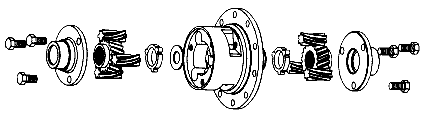
The Detroit TrueTrac is advertised as a 'torque-proportioning' differential that is entirely gear-based, which means it needs no clutches or special oil. It is available for the front and rear of all toyota 4x4s through 1995. It behaves like an open differential most of the time, but when a loss of traction occurs, its small pinion gears (which basically perform the same function as spider gears in an open differential) separate slighly from the side gears and wedge into a pocket on the carrier, which sends torque to the non-slipping wheel. The picture below is the internals of a TrueTrac.
Lockers
A locking differential has characteristics of both open diffs and spools. There are many available for Toys. A locker behaves normally much like an open diff, but somehow (either automatically or manually, depending on the model) locks up like a spool.
The ARB Air Locker is a highly-regarded locker that is manually operated via a switch that controls compressed air that locks up the diff. When it is off, the diff behaves exactly like an open diff. When you press the switch, you have a spool and its awesome traction. This diff is expensive and hard to install, but having manual control is very nice for a rig that spends time both on and off the pavement.
Automatic lockers operate on a 'ratcheting' principle. Neither wheel on the axle can turn slower than the ring gear, but they can turn faster. Automatic lockers take some getting used to when turning - the inside wheel powers your truck around the corner, while the outside wheel is 'freewheeling'. With an open diff, the outside wheel does the powering. Automatic lockers are cheaper than the air locker and provide the same traction, though there is some ratcheting noise and wheel hop on the freeway. They can cause some spooky steering on slippery surfaces. Because of this, a lot of people don't suggest using them in the front axle. Some lockers, such as the Lock-Rite and Detroit EZ-locker, can be installed without changing some of the critical adjustments in the third member, so installation is much quicker and easier (i.e. you can do it yourself) than other types of carriers.
 |
Off-Road.com Newsletter Join our Weekly Newsletter to get the latest off-road news, reviews, events, and alerts! |
Follow @Off-Road

 Your Privacy Choices